
Jefferson County Value Types
There is no single "property value" field in Alabama. The state begins with an appraised value. It then applies the assessment ratio for the property's class to produce an assessed value. Exemptions and the statutory cap can then change the taxable assessed value. A deed's consideration belongs to a specific transfer. A Census median, by contrast, describes a whole area. Keep every label with its number.
| Value | What It Is | Where |
|---|---|---|
| Appraised or market value | County mass-appraisal estimate before the class ratio | CAPture assessment record |
| Assessed value | Appraised value multiplied by the state class ratio | CAPture and assessment roll |
| Taxable assessed value | Assessment figure after applicable limits or exemptions | Assessment and tax records |
| Recorded consideration | Amount stated in connection with a transfer | Landmark deed record |
Class III property, which includes qualifying owner-occupied residential property, carries a 10 percent assessment ratio. Class II uses 20 percent, and Class I uses 30 percent. Do not read a 10 percent ratio as a 10 percent tax bill. Millage rates and any exemptions enter the calculation later. The ratio is only one step toward the final tax.
Alabama's Jefferson Value Formula
The Alabama Department of Revenue assessment guide lays out the core formula: appraised value multiplied by the assessment class ratio yields assessed value. Millage is applied after that step for tax purposes. This is why an assessed value can sit far below an appraised value without signaling a discount or a defective record. Classification drives the math. Confirm the class and use printed on the county record rather than guessing a ratio from how a building looks. Homestead and senior provisions can change the taxable result, but they never turn an assessment into a sale appraisal.
Read Jefferson Assessed Values
CAPture/E-Ring supports searches by Property Address, Mailing Address, Owner, and Parcel Number, along with a year selector. Its results include valuation, tax information, land and building details, deed information, sketches, and GIS links. Individual subfields may vary. Record only what the displayed label actually says.
- Search the address or parcel number in CAPture.
- Select and record the relevant assessment year.
- Copy the appraised, assessed, class, land, and improvement labels shown.
- Check Landmark separately when recorded consideration is relevant.
- Assessed value
- The appraised value after the class ratio is applied.
- Appraised value
- The county's mass-appraisal estimate for assessment.
- Assessment ratio
- The state percentage used to convert appraised value to assessed value.
- Reassessment
- A later review that may change the record's appraised figure.
See Jefferson Value Instructions
Jefferson County's CAPture help pages spell out how to format a parcel number, which search modes the system offers, and how results are grouped. Reading the official CAPture instructions first makes year-to-year value comparisons far easier.
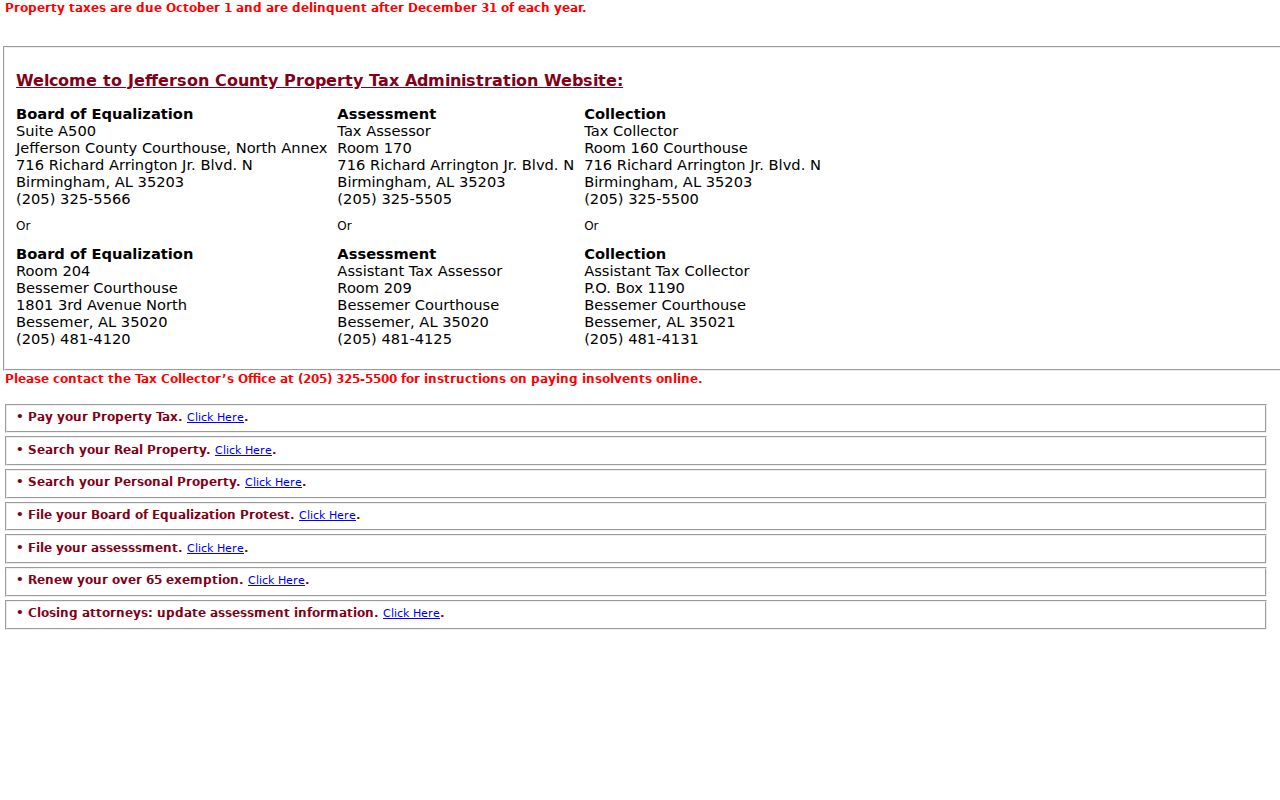
The official county page shows the route into Jefferson County assessment data. Pair it with the parcel's live year and field labels.
Jefferson Sale Consideration Differs
Landmark offers a Consideration search mode, and recorded instruments may carry a consideration amount. That number belongs to the recorded transaction itself. It may not match the county's current appraised value. It may not match the assessed value either. It may not equal an arm's-length market result. Gifts, family transfers, and entity changes call for extra care. Use the deed's date, type, parties, instrument number, and legal description when weighing any figure. The value question always ends at the source and its field label. For a full ownership chain, take the Jefferson County deed records route.
Jefferson's Seven Percent Cap
Alabama Act 2024-344 guidance describes a 7 percent cap on year-to-year growth in taxable assessed value. It applies to eligible Class II and Class III real property. State guidance also lists exceptions, including changes in use or class. The cap matters when comparing taxable assessments across years. It does not promise that market value rose by 7 percent or less. It says nothing about sale price either. Jefferson County's Board of Equalization material for 2026 said the cap would be reflected on the October bill. Check that timing against the current county notice. Compare like fields from like years.
Exemptions Change Taxable Value
Homestead, age, disability, and other eligibility rules can change taxable outcomes. CAPture's assessment filing form collects class use, owner and contact information, and age or disability indicators. It also gathers income fields and supporting uploads. That form exists for filing assessment or exemption information, not for public parcel results. Two homes with nearly identical appraised values can show different taxable figures. The gap is not proof that one house would sell for less. Questions about bills, exemptions, or protests go to the Tax Assessor, the Board of Equalization, and the Tax Collector. More detail appears on Jefferson County property tax records.
City Medians Are Not Parcels
Census QuickFacts figures offer broad owner-occupied value context for Birmingham, Hoover, and Vestavia Hills. Those medians summarize entire city populations, not CAPture appraisals. They cannot estimate a specific parcel's worth. ZIP labels or municipal borders often blur the lines. Confirm a parcel's jurisdiction, assessment year, use class, and source before comparing anything. Note its land and improvement characteristics too. A city trend adds context. But parcel evidence and a professional appraisal still carry the weight.
Date Every Jefferson Value
CAPture, the Tax Collector, Landmark, and city data do not refresh as one system. A new deed can appear before the assessment roll changes. A value conclusion needs context. Include the tax year, source date, field label, and parcel number. Note any unresolved mismatch too. Never present one annual change as a proven market trend. Keep appraised, assessed, taxable, and consideration amounts separate. That small discipline keeps a search result from becoming a claim its source never made.
Compare a Jefferson Parcel Across Years
Pull the same parcel number for every year you compare. First confirm the tract never split, merged, or shifted class. A changed parcel makes the comparison meaningless. Save the selected year inside CAPture along with the appraised and assessed labels. Note the property class too. Any exemption context matters. Only a certain table tells a true year-to-year story. Each row must reflect the same field and the same parcel.
- Record the parcel number, situs, and assessment year.
- Copy each value exactly under its portal label.
- Check class or use changes before calculating a percentage.
- Keep a deed consideration in a separate sale column.
The Jefferson County Board of Equalization posts valuation and protest information, with office access in Birmingham and Bessemer. Its material helps explain the county's current assessment climate. A roll value is still not an independent appraisal.
Get Jefferson Valuation Records Without the Portal
When the portal comes up empty, call instead. The Tax Assessor at 205-325-5505 can look up the parcel from an address. The Bessemer assistant assessor at 205-481-4127 can help with whatever parcel clues you have. Board of Equalization offices keep public computer terminals for the same purpose. Their posted policy allows ten minutes per person when others are waiting. Confirm the roll year and the field on screen. Rely on the figure only then.
A focused public-records request can also reach an identifiable assessment writing that never appears online. Name the parcel, the tax year, and the exact record wanted. Do not ask the county to guess at a sale price. Check Landmark for a recorded consideration amount. You can also request the deed itself from the Probate Record Room that holds it. Those channels keep assessment evidence and transaction evidence in their proper lanes.
Jefferson Property Value Limits
Assessors rely on mass-appraisal methods applied across many properties at once. The resulting public value serves assessment administration. It is not a tailored opinion for a sale, since physical condition, private improvements, unusual rights, and current market terms may never be captured the same way or at the same time.
Value versus price. A Jefferson County assessed value is for taxation. It is not a prediction of sale price and is not a licensed appraisal.